
Threadless vs. Threaded Jewellery: Which Should You Choose?
Share
Almost every flat-back or labret-style piece you'll shop for comes in one of two closure systems: threaded or threadless. They look nearly identical from the outside, but how they actually stay in your ear is completely different — and that difference affects how easy the jewellery is to live with day to day.
How Each System Works
Threaded jewellery secures itself the way a bolt does: the decorative top has fine internal threads that screw directly onto the post. It's a mechanical connection — turn it, and it tightens or loosens.
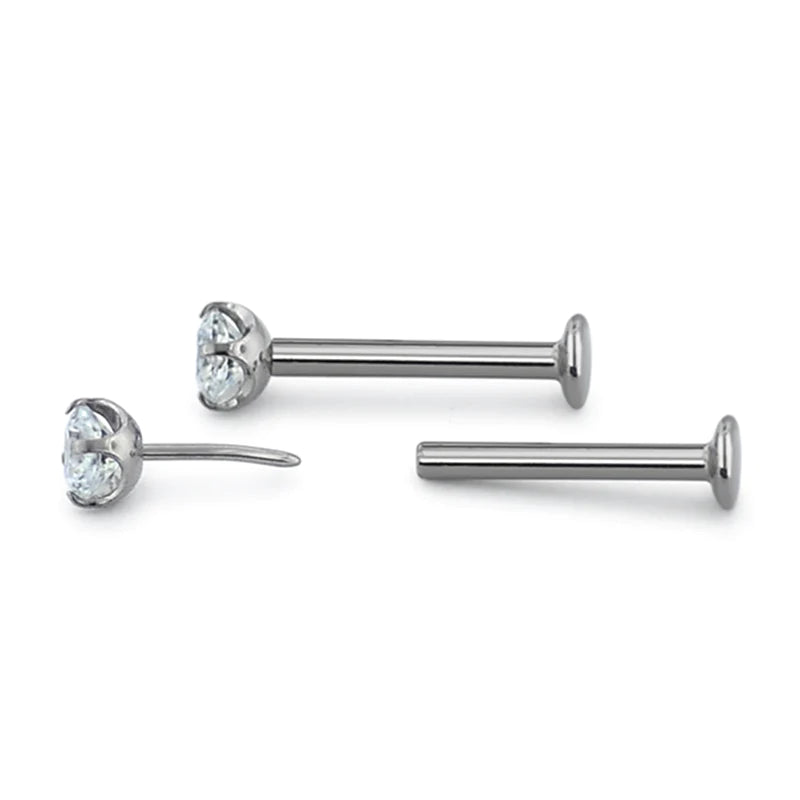
Threadless jewellery uses a completely different mechanism: the top has a thin pin with a slight bend in it, which pushes into a hollow post and holds itself in place through friction against the tension of that bend — no screwing involved at all. For the full mechanics, see our How to Use Threadless Jewellery guide.
Where Threadless Wins
- Speed — push in, done. No carefully lining up fine threads.
- No accidental loosening — threaded tops can work loose over the course of a day through normal movement; threadless tops hold their friction fit without any rotation involved
- No cross-threading — one of the most common threaded-jewellery mistakes is screwing the top in slightly crooked, which can strip or damage the threads permanently. Threadless removes that failure mode entirely.
- Easier for frequent changes — if you like to switch up your jewellery often, threadless is noticeably faster and less fiddly
Where Threaded Still Makes Sense
- Familiarity — threaded jewellery has been the industry standard for longer, and many people (and some piercers) simply default to it
- No pin to bend — threadless jewellery relies on the pin holding its bend correctly; if you're someone who'd rather not think about that variable at all, threaded avoids it entirely
- Wide availability — threaded is still the more universally available system across brands, useful if you're mixing pieces from multiple sources
Does One Cause More Irritation Than the Other?
The closure mechanism itself doesn't meaningfully affect irritation risk — material is what determines that (see our Materials Guide for the full picture on titanium, surgical steel, and bioplastic). Both threaded and threadless jewellery are equally safe when made from genuine implant-grade materials and sized correctly for your piercing.
The Bottom Line
If you value speed and simplicity and don't mind learning the push-fit technique, threadless is the more modern, lower-friction (literally and figuratively) choice for most people. If you'd rather have a mechanical screw connection with nothing to bend or maintain, threaded remains a completely valid option. Neither is objectively "better" from a safety standpoint — it comes down to personal preference for how you want to interact with your jewellery day to day.
Frequently Asked Questions
Can threadless jewellery fall out more easily than threaded?
Not when used correctly — a properly bent pin holds securely through normal daily movement. See our threadless usage guide for correct insertion technique.
Is threadless jewellery more expensive?
Not inherently — pricing depends on the design and material, not the closure mechanism.
Can I mix threaded and threadless pieces in the same piercing over time?
You can switch between systems, but each individual piece is either threaded or threadless — check the product listing before buying to confirm which system a specific piece uses.
Ready to try threadless? Shop our Threadless Push-In Collection.